Table of Content
Title

Connect with
us to begin your healing journey today.
Experience holistic healing that restores balance and vitality.
The Spiritual Side of Healing: Integrating Mind, Body, and Meaning
The Spiritual Side of Healing: Integrating Mind, Body, and Meaning
The Spiritual Side of Healing: Integrating Mind, Body, and Meaning
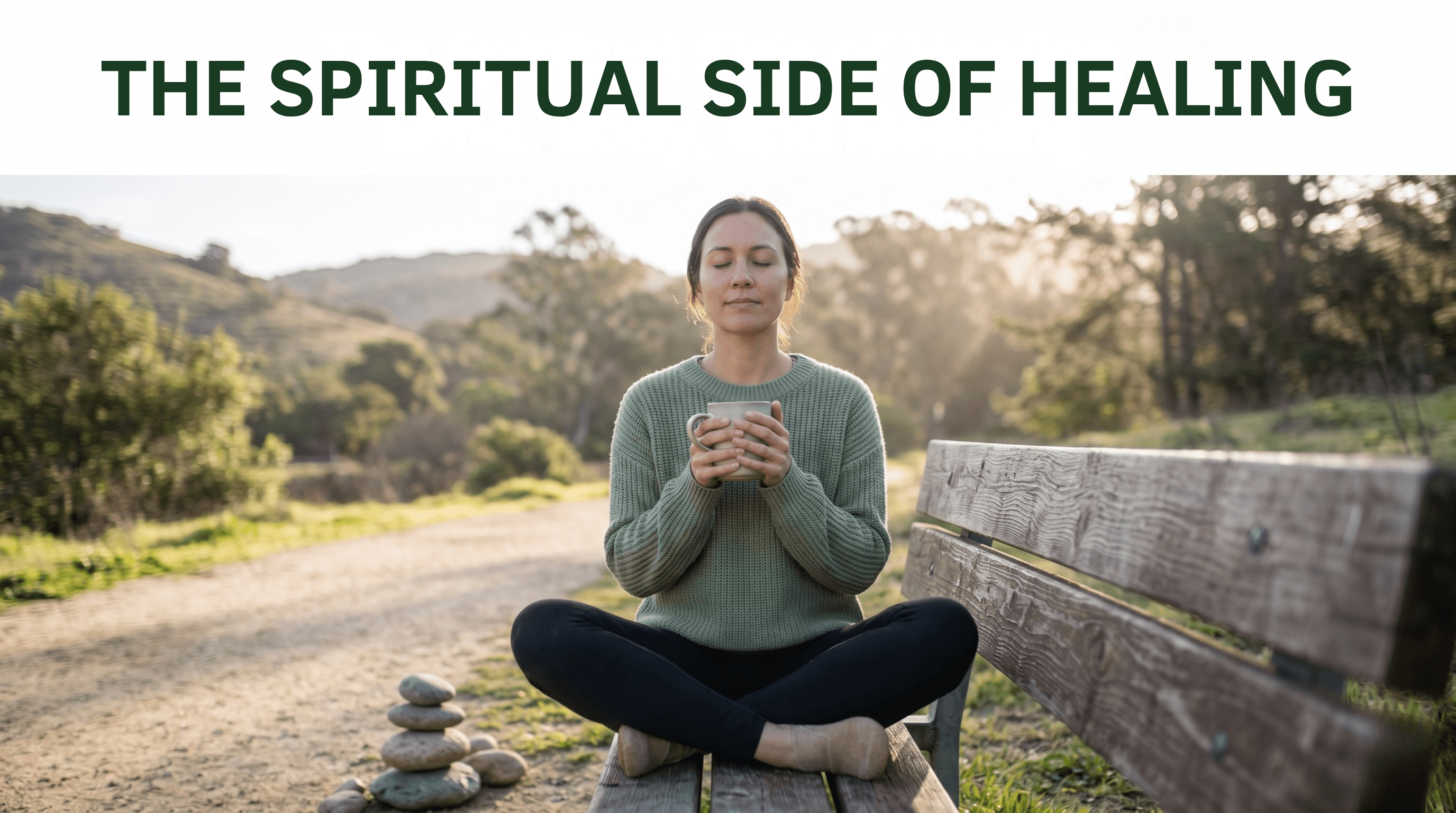
Healing has traditionally been thought of as something that happens to the body, while attention and support for the mind have increasingly been recognized as complementary to physical recovery. Yet even when symptoms improve, people often notice lingering emotional heaviness, confusion, or a sense of disconnection from themselves.
Spirituality is the part of human experience that shapes how we find meaning and purpose, and how we feel connected; to ourselves, to others, to the world around us, and to something larger than our immediate circumstances. It is not just about religion or belief systems. Supporting this dimension can help the recovery process feel more integrated, grounded, and complete. You can also explore how thoughts and emotions influence healing in The Science and Spirit of Self-Talk: How Your Words Shape Your Health.
Reframing Spirituality as a Practical Source of Support
Spirituality is often misunderstood as abstract or separate from daily life. It is deeply practical. It appears in the quiet questions people carry during illness, injury, or major life transitions: Why is this happening? How do I live with this? What does my body need right now?
In practical terms, spirituality relates to making meaning, staying connected to values, and orienting oneself during stress. For some, this may involve faith or religious practice; for others, it emerges through nature, relationships, creativity, reflective practices, or shared human experience. What matters is whether it helps the person feel steadier, supported, and less alone.
From a physiological perspective, this sense of meaning and connection can gently regulate the nervous system, helping the body shift out of constant threat mode and into states that allow rest, digestion, and repair. This regulation does not require formal spiritual practice or stillness. It often arises through reflection, connection, and belonging, sometimes strengthened through supportive communities where shared experiences provide stability.
When the Spiritual Dimension Is Overlooked
When spiritual needs are not acknowledged, people may experience spiritual distress: feeling lost, disconnected, or unable to make sense of their experience. Even with effective medical or psychological care, unresolved distress can increase anxiety, prolong emotional stress, and leave people feeling out of balance. Healing may stall not because the body cannot recover, but because the person lacks an internal supportive framework.
Addressing the spiritual dimension complements medical and psychological care by helping the whole system feel safer and more oriented toward healing. Complementary approaches such as How Hypnotherapy Supports Stress Management Naturally may also help reduce emotional stress and support nervous system regulation.
Meaning, Stress, and the Nervous System
Psychiatrist and neurologist Viktor Frankl observed that while pain is often unavoidable, suffering is shaped by meaning. When experiences feel overwhelming or senseless, distress intensifies. When held within a meaningful context, people often demonstrate greater resilience.
Research supports this insight: chronic stress keeps the nervous system in prolonged protection mode, activating inflammatory pathways, and limiting the body’s capacity for repair. Higher spiritual well-being is associated with lower markers of inflammation linked to chronic illness. In this sense, meaning has tangible effects on the body. Gentle movement practices that encourage relaxation and balance may further support nervous system health, as discussed in Tai Chi Healing: Restoring Balance in Body and Mind.

Practical Ways People Engage the Spiritual Dimension
Just as meditation doesn’t work for everyone, spirituality looks different for each person. Accessible ways to connect include:
Reflective meaning-making: Exploring what an experience may be asking of you now, rather than why it happened. This reduces internal resistance and fosters self-compassion.
Clarifying values: Identifying what matters most to guide decision making, conserve energy, and reduce overwhelm.
Narrative reflection: Understanding your story, where you have been, and how current experiences fit into your life.
Connection and belonging: Nurturing ties with others, community, nature, creativity, or service. Shared experience and understanding provide stability and emotional support.
Inner listening: Noticing bodily cues, intuition, or inner guidance without judgment to strengthen self-trust. Positive inner dialogue can also influence emotional and physical well-being, which is explored further in The Power of Self-Talk: Rewiring Your Brain and Body for Healing.
There Is No “Right” Way to Be Spiritual
If a particular approach does not resonate, it does not mean something is wrong. Some people feel grounded through prayer, others through movement, time in nature, conversation, or creative expression. The goal is to feel more settled, connected, and supported.
Healing the Whole Person
Spirituality in healing is not about adopting a belief system. It is about reconnecting with inner resources that help people navigate challenges with steadiness and clarity. When meaning and connection are supported, emotional distress is reduced, the nervous system settles, and the body is freer to heal. Whole-person care honors the body, mind, and spirit together rather than in isolation.
Integrating Spiritual Care at the Center for Natural Medicine
At the Center for Natural Medicine, healing is most effective when physical, emotional, and spiritual needs are addressed together. Our practitioners meet each person where they are, honoring their beliefs, values, and life experiences. Through personalized care, we support patients in reconnecting with meaning and a sense of purpose alongside physical and emotional healing. This approach fosters resilience, self-trust, and a deeper sense of well-being.
If you are curious about exploring healing in a way that supports your whole self, our team is here to help. We invite you to take the next step toward care that honors every part of you: body, mind, and spirit.
References:
Frankl, V. E. (2006). Man’s search for meaning. Beacon Press.
Koenig, H. G. (2012). Religion, spirituality, and health: Research and clinical implications. ISRN Psychiatry, 2012, Article 278730. https://www.ncbi.nlm.nih.gov/pmc/articles/PMC3671693/
Puchalski, C. M., Vitillo, R., Hull, S. K., & Reller, N. (2014). Improving the spiritual dimension of whole person care: Reaching national and international consensus. Journal of Palliative Medicine, 17(6), 642–656. https://www.ncbi.nlm.nih.gov/pmc/articles/PMC4038982/
Vagnini, K. M., Morozink Boylan, J., Adams, M., & Masters, K. S. (2024). Multidimensional religiousness and spirituality are associated with lower interleukin-6 and C-reactive protein at midlife: Findings from the Midlife in the United States Study. Annals of Behavioral Medicine, 58(8), 552–562. https://academic.oup.com/abm/article/58/8/552/7698041
Frequently Asked Questions
What does spirituality mean in the context of healing?
Spirituality in healing refers to the ways people find meaning, purpose, and connection during difficult experiences. It may involve faith or religion for some, while for others it is expressed through relationships, nature, creativity, reflection, or community support.
How does spirituality support the healing process?
Supporting the spiritual dimension can help people feel more grounded, connected, and emotionally supported. This sense of meaning and connection may also help regulate the nervous system, reduce stress, and create conditions that support the body’s natural healing processes.
Is spirituality the same as religion?
No. While spirituality may include religious beliefs or practices, it is broader than religion alone. Spirituality relates to how people understand themselves, connect with others, and make sense of life experiences.
What is spiritual distress?
Spiritual distress can occur when people feel disconnected, lost, hopeless, or unable to make sense of what they are experiencing. It may contribute to emotional stress and make recovery feel more difficult, even when physical symptoms are improving.
Why is whole-person healing important?
Whole-person healing recognizes that physical, emotional, and spiritual well-being are deeply interconnected. Addressing all aspects of a person’s experience can help support more balanced, integrated, and sustainable healing.
Healing has traditionally been thought of as something that happens to the body, while attention and support for the mind have increasingly been recognized as complementary to physical recovery. Yet even when symptoms improve, people often notice lingering emotional heaviness, confusion, or a sense of disconnection from themselves.
Spirituality is the part of human experience that shapes how we find meaning and purpose, and how we feel connected; to ourselves, to others, to the world around us, and to something larger than our immediate circumstances. It is not just about religion or belief systems. Supporting this dimension can help the recovery process feel more integrated, grounded, and complete. You can also explore how thoughts and emotions influence healing in The Science and Spirit of Self-Talk: How Your Words Shape Your Health.
Reframing Spirituality as a Practical Source of Support
Spirituality is often misunderstood as abstract or separate from daily life. It is deeply practical. It appears in the quiet questions people carry during illness, injury, or major life transitions: Why is this happening? How do I live with this? What does my body need right now?
In practical terms, spirituality relates to making meaning, staying connected to values, and orienting oneself during stress. For some, this may involve faith or religious practice; for others, it emerges through nature, relationships, creativity, reflective practices, or shared human experience. What matters is whether it helps the person feel steadier, supported, and less alone.
From a physiological perspective, this sense of meaning and connection can gently regulate the nervous system, helping the body shift out of constant threat mode and into states that allow rest, digestion, and repair. This regulation does not require formal spiritual practice or stillness. It often arises through reflection, connection, and belonging, sometimes strengthened through supportive communities where shared experiences provide stability.
When the Spiritual Dimension Is Overlooked
When spiritual needs are not acknowledged, people may experience spiritual distress: feeling lost, disconnected, or unable to make sense of their experience. Even with effective medical or psychological care, unresolved distress can increase anxiety, prolong emotional stress, and leave people feeling out of balance. Healing may stall not because the body cannot recover, but because the person lacks an internal supportive framework.
Addressing the spiritual dimension complements medical and psychological care by helping the whole system feel safer and more oriented toward healing. Complementary approaches such as How Hypnotherapy Supports Stress Management Naturally may also help reduce emotional stress and support nervous system regulation.
Meaning, Stress, and the Nervous System
Psychiatrist and neurologist Viktor Frankl observed that while pain is often unavoidable, suffering is shaped by meaning. When experiences feel overwhelming or senseless, distress intensifies. When held within a meaningful context, people often demonstrate greater resilience.
Research supports this insight: chronic stress keeps the nervous system in prolonged protection mode, activating inflammatory pathways, and limiting the body’s capacity for repair. Higher spiritual well-being is associated with lower markers of inflammation linked to chronic illness. In this sense, meaning has tangible effects on the body. Gentle movement practices that encourage relaxation and balance may further support nervous system health, as discussed in Tai Chi Healing: Restoring Balance in Body and Mind.
Practical Ways People Engage the Spiritual Dimension
Just as meditation doesn’t work for everyone, spirituality looks different for each person. Accessible ways to connect include:
Reflective meaning-making: Exploring what an experience may be asking of you now, rather than why it happened. This reduces internal resistance and fosters self-compassion.
Clarifying values: Identifying what matters most to guide decision making, conserve energy, and reduce overwhelm.
Narrative reflection: Understanding your story, where you have been, and how current experiences fit into your life.
Connection and belonging: Nurturing ties with others, community, nature, creativity, or service. Shared experience and understanding provide stability and emotional support.
Inner listening: Noticing bodily cues, intuition, or inner guidance without judgment to strengthen self-trust. Positive inner dialogue can also influence emotional and physical well-being, which is explored further in The Power of Self-Talk: Rewiring Your Brain and Body for Healing.
There Is No “Right” Way to Be Spiritual
If a particular approach does not resonate, it does not mean something is wrong. Some people feel grounded through prayer, others through movement, time in nature, conversation, or creative expression. The goal is to feel more settled, connected, and supported.
Healing the Whole Person
Spirituality in healing is not about adopting a belief system. It is about reconnecting with inner resources that help people navigate challenges with steadiness and clarity. When meaning and connection are supported, emotional distress is reduced, the nervous system settles, and the body is freer to heal. Whole-person care honors the body, mind, and spirit together rather than in isolation.
Integrating Spiritual Care at the Center for Natural Medicine
At the Center for Natural Medicine, healing is most effective when physical, emotional, and spiritual needs are addressed together. Our practitioners meet each person where they are, honoring their beliefs, values, and life experiences. Through personalized care, we support patients in reconnecting with meaning and a sense of purpose alongside physical and emotional healing. This approach fosters resilience, self-trust, and a deeper sense of well-being.
If you are curious about exploring healing in a way that supports your whole self, our team is here to help. We invite you to take the next step toward care that honors every part of you: body, mind, and spirit.
References:
Frankl, V. E. (2006). Man’s search for meaning. Beacon Press.
Koenig, H. G. (2012). Religion, spirituality, and health: Research and clinical implications. ISRN Psychiatry, 2012, Article 278730. https://www.ncbi.nlm.nih.gov/pmc/articles/PMC3671693/
Puchalski, C. M., Vitillo, R., Hull, S. K., & Reller, N. (2014). Improving the spiritual dimension of whole person care: Reaching national and international consensus. Journal of Palliative Medicine, 17(6), 642–656. https://www.ncbi.nlm.nih.gov/pmc/articles/PMC4038982/
Vagnini, K. M., Morozink Boylan, J., Adams, M., & Masters, K. S. (2024). Multidimensional religiousness and spirituality are associated with lower interleukin-6 and C-reactive protein at midlife: Findings from the Midlife in the United States Study. Annals of Behavioral Medicine, 58(8), 552–562. https://academic.oup.com/abm/article/58/8/552/7698041
Frequently Asked Questions
What does spirituality mean in the context of healing?
Spirituality in healing refers to the ways people find meaning, purpose, and connection during difficult experiences. It may involve faith or religion for some, while for others it is expressed through relationships, nature, creativity, reflection, or community support.
How does spirituality support the healing process?
Supporting the spiritual dimension can help people feel more grounded, connected, and emotionally supported. This sense of meaning and connection may also help regulate the nervous system, reduce stress, and create conditions that support the body’s natural healing processes.
Is spirituality the same as religion?
No. While spirituality may include religious beliefs or practices, it is broader than religion alone. Spirituality relates to how people understand themselves, connect with others, and make sense of life experiences.
What is spiritual distress?
Spiritual distress can occur when people feel disconnected, lost, hopeless, or unable to make sense of what they are experiencing. It may contribute to emotional stress and make recovery feel more difficult, even when physical symptoms are improving.
Why is whole-person healing important?
Whole-person healing recognizes that physical, emotional, and spiritual well-being are deeply interconnected. Addressing all aspects of a person’s experience can help support more balanced, integrated, and sustainable healing.
Latest Blogs

What Is Colonic Hydrotherapy? Procedure, Benefits, and Safety
Oct 17, 2026

What Conventional Medicine Gets Right and Functional Medicine Gets Right: A Fair Comparison
Oct 17, 2026

What Is a Holistic Health Practitioner? Roles, Benefits, and What to Expect
Oct 12, 2026

What Is Outpatient Mental Health Therapy? A Clear, Honest Breakdown
Aug 31, 2026

The 90-Day Wall: Why Most Wellness Plans Collapse by Month Three
Aug 6, 2026

Why More People Are Turning to a Functional Medicine Health Coach for Root-Cause Healing
Jul 14, 2026
Connect with us to begin your healing journey today.
Experience holistic healing that restores balance and vitality.

Connect with us to begin
your healing journey today.
Experience holistic healing that restores balance and vitality.
Connect with us to begin
your healing journey today.
Experience holistic healing that restores balance and vitality.
Connect with us to begin
your healing journey today.
Experience holistic healing that restores balance and vitality.
Latest New & Blogs
Related Blog Post
Related Blog Post
Newsletter Signup
Newsletter Signup
Newsletter Signup
Newsletter Signup
Get wellness tips, health insights, and exclusive updates in your inbox.
Get wellness tips, health insights, and exclusive updates in your inbox.
Get wellness tips, health insights, and exclusive updates in your inbox.
Get wellness tips, health insights, and exclusive updates in your inbox.