Table of Content
Title

Connect with
us to begin your healing journey today.
Experience holistic healing that restores balance and vitality.
Navigating the Healthcare System: Finding the Right Approach
Navigating the Healthcare System: Finding the Right Approach
Navigating the Healthcare System: Finding the Right Approach
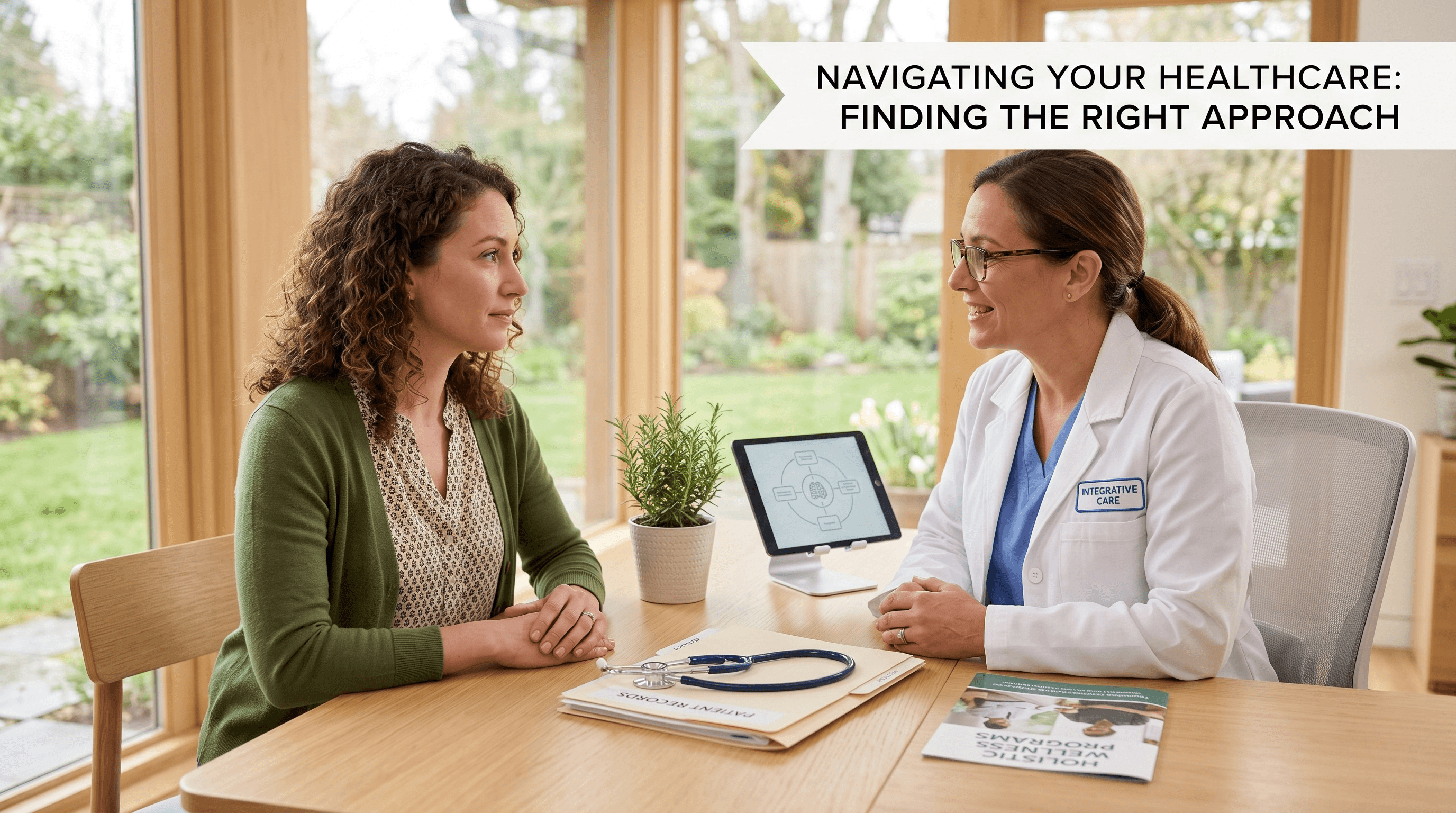
Have you ever felt confused trying to navigate your healthcare? Maybe you've started with a visit to your primary care physician, shared your symptoms, and left with a few answers, but still felt like pieces of the puzzle were missing. Or maybe you've explored more holistic approaches and found yourself wondering if you should also be doing more from a conventional medical standpoint. It's a common place to find yourself. To learn more about what a patient-centered approach can look like, our services page is a helpful place to start.
We're often led to believe we must choose one path or the other, but both conventional and holistic approaches play an important role in your well-being. The key is understanding when and how to use each one.
What Conventional Medicine Does Really Well
Conventional (or allopathic) medicine is what most of us are familiar with. Grounded in research and using diagnostics, medications, and procedures to treat disease, there are times when this approach is essential. If you're dealing with something acute like a car accident, a broken bone, an infection, or a severe allergic reaction such as anaphylaxis, this is the system designed to respond quickly and effectively. It's also where you'll find advanced imaging, lab testing, and surgical interventions when needed.
Conventional medicine can also be supportive in managing chronic conditions, and many patients do find practitioners who take a more comprehensive approach. At the same time, it often focuses on diagnosing and managing symptoms, frequently through medication, which can be helpful for stabilization, even if it doesn't always address the underlying contributing factors. If you're curious about how testing beyond standard diagnostics can uncover more, this article on what a GI MAP stool test can reveal is worth reading.
Where Holistic Care Can Fill in the Gaps
At the same time, you may have experienced situations where routine testing, such as blood work, imaging, or procedures like colonoscopies, come back within normal ranges, yet you still don't feel your best. Many people describe this experience as knowing something isn't quite right, even when there's no clear explanation in the results. This is often where a more holistic approach can be helpful. For a closer look at what may actually be making you feel unwell, this piece on the case for a holistic approach to health explores exactly that.
Holistic care looks at the full picture: your physical health, as well as your stress levels, sleep, diet, environment, relationships, and other relevant aspects of your history that may not always be fully explored during a conventional visit. Instead of focusing only on symptoms, it asks a different question: Why might this be happening in the first place? It works to understand the root causes that may have been contributing to your health over time.
This approach can be especially helpful for:
Ongoing or chronic concerns
Digestive issues, fatigue, or hormonal imbalances
Situations where you feel like you've tried everything, but still don't have clear answers
It also tends to involve more education and conversation, helping you better understand what may be happening in your body and what you can do to support it. In many cases, this added layer of guidance can feel empowered because it gives people tools to actively participate in their own healing process as a co-collaborator in their care. If you've been wondering why healing hasn't happened yet, understanding the invisible barriers to healing can offer some real clarity.
Bringing Both Together
What we're seeing increasingly is a shift toward a blended model of care that brings both approaches together. Integrative medicine combines conventional and complementary care while also considering the broader aspects of a person's health, including mental, emotional, environmental, and lifestyle factors. This is where things often start to make more sense, because in real life, comprehensive health care rarely fits neatly into one system. If you'd like to see how this integrative model looks in practice, our naturopathic care page gives a full overview of how we approach it.
You might use conventional care for diagnosis and immediate treatment, while also working with a holistic provider to understand patterns, support your body, and make sustainable changes. It's not about choosing sides; it's about using the right tools at the right time. Understanding how your mind and body work together as part of this process is also valuable — this article on how the mind helps real physiological change is a great companion read.

How Do You Know Where to Start?
This is usually the part people struggle with most. If you're not sure where to begin, it can help to pause and ask yourself a few simple questions:
Is this something urgent or new? If so, starting with a medical doctor is often the best step.
Has this been going on for a while without clear answers? A more holistic or integrative approach may help you look deeper.
Am I mostly looking for symptom relief, or do I want to understand what's contributing to this?
Do I feel heard and supported in my current care?
Sometimes the answer isn't about changing everything or starting over; it's about adding another layer of support. Exploring what functional medicine health coaching looks like can be a practical next step if you're ready to dig deeper into what's contributing to how you feel.
A More Realistic Way to Think About Healthcare
If there's one takeaway, it's this: You don't have to choose one approach for the rest of your life. There may be times when conventional medicine is exactly what you need, and other times when a more holistic approach helps you connect the dots in a way that hasn't happened before. Your needs can change, and your care can change with you. To explore how listening to your body plays into all of this, this piece on what your body is trying to tell you is a worthwhile read.
When to Seek Additional Support
If you're feeling stuck or like you're piecing things together on your own, it may be time for a more personalized approach.
At the Center for Natural Medicine, our naturopathic doctors provide comprehensive clinical assessments to help identify underlying imbalances and contributing factors. From there, our team, including functional medicine health coaching, can help guide you through practical, sustainable changes that support your long-term health. You can learn more about our practitioners by visiting our team page, or reach out directly through our contact page.
You don't have to navigate this alone. Sometimes, having the right support team can make things start to make more sense.
References
Healthline. (n.d.). What is a holistic doctor? https://www.healthline.com/health/holistic-doctor
Maizes, V., Rakel, D., & Niemiec, C. (2009). Integrative medicine and patient-centered care. Explore, 5(5), 277–289. https://pmc.ncbi.nlm.nih.gov/articles/PMC6173273/
Medical News Today. (n.d.). Allopathic medicine: Definition, benefits, and more. https://www.medicalnewstoday.com/articles/allopathic-medicine
Frequently Asked Questions
Do I have to choose between conventional and holistic care?
No. Many people find that using both approaches together provides more complete support.
When should I see a medical doctor first?
For urgent symptoms, new concerns, or when diagnostic testing is needed.
What does a holistic provider focus on?
Holistic providers look at the whole person, including lifestyle, stress, nutrition, and underlying contributors to health concerns.
Can I work with both at the same time?
Yes, and this is often where people see the most benefit.
What if I still don't feel better after trying different approaches?
This may be a sign that a more individualized, root-cause approach could help uncover what is being missed.
Have you ever felt confused trying to navigate your healthcare? Maybe you've started with a visit to your primary care physician, shared your symptoms, and left with a few answers, but still felt like pieces of the puzzle were missing. Or maybe you've explored more holistic approaches and found yourself wondering if you should also be doing more from a conventional medical standpoint. It's a common place to find yourself. To learn more about what a patient-centered approach can look like, our services page is a helpful place to start.
We're often led to believe we must choose one path or the other, but both conventional and holistic approaches play an important role in your well-being. The key is understanding when and how to use each one.
What Conventional Medicine Does Really Well
Conventional (or allopathic) medicine is what most of us are familiar with. Grounded in research and using diagnostics, medications, and procedures to treat disease, there are times when this approach is essential. If you're dealing with something acute like a car accident, a broken bone, an infection, or a severe allergic reaction such as anaphylaxis, this is the system designed to respond quickly and effectively. It's also where you'll find advanced imaging, lab testing, and surgical interventions when needed.
Conventional medicine can also be supportive in managing chronic conditions, and many patients do find practitioners who take a more comprehensive approach. At the same time, it often focuses on diagnosing and managing symptoms, frequently through medication, which can be helpful for stabilization, even if it doesn't always address the underlying contributing factors. If you're curious about how testing beyond standard diagnostics can uncover more, this article on what a GI MAP stool test can reveal is worth reading.
Where Holistic Care Can Fill in the Gaps
At the same time, you may have experienced situations where routine testing, such as blood work, imaging, or procedures like colonoscopies, come back within normal ranges, yet you still don't feel your best. Many people describe this experience as knowing something isn't quite right, even when there's no clear explanation in the results. This is often where a more holistic approach can be helpful. For a closer look at what may actually be making you feel unwell, this piece on the case for a holistic approach to health explores exactly that.
Holistic care looks at the full picture: your physical health, as well as your stress levels, sleep, diet, environment, relationships, and other relevant aspects of your history that may not always be fully explored during a conventional visit. Instead of focusing only on symptoms, it asks a different question: Why might this be happening in the first place? It works to understand the root causes that may have been contributing to your health over time.
This approach can be especially helpful for:
Ongoing or chronic concerns
Digestive issues, fatigue, or hormonal imbalances
Situations where you feel like you've tried everything, but still don't have clear answers
It also tends to involve more education and conversation, helping you better understand what may be happening in your body and what you can do to support it. In many cases, this added layer of guidance can feel empowered because it gives people tools to actively participate in their own healing process as a co-collaborator in their care. If you've been wondering why healing hasn't happened yet, understanding the invisible barriers to healing can offer some real clarity.
Bringing Both Together
What we're seeing increasingly is a shift toward a blended model of care that brings both approaches together. Integrative medicine combines conventional and complementary care while also considering the broader aspects of a person's health, including mental, emotional, environmental, and lifestyle factors. This is where things often start to make more sense, because in real life, comprehensive health care rarely fits neatly into one system. If you'd like to see how this integrative model looks in practice, our naturopathic care page gives a full overview of how we approach it.
You might use conventional care for diagnosis and immediate treatment, while also working with a holistic provider to understand patterns, support your body, and make sustainable changes. It's not about choosing sides; it's about using the right tools at the right time. Understanding how your mind and body work together as part of this process is also valuable — this article on how the mind helps real physiological change is a great companion read.
How Do You Know Where to Start?
This is usually the part people struggle with most. If you're not sure where to begin, it can help to pause and ask yourself a few simple questions:
Is this something urgent or new? If so, starting with a medical doctor is often the best step.
Has this been going on for a while without clear answers? A more holistic or integrative approach may help you look deeper.
Am I mostly looking for symptom relief, or do I want to understand what's contributing to this?
Do I feel heard and supported in my current care?
Sometimes the answer isn't about changing everything or starting over; it's about adding another layer of support. Exploring what functional medicine health coaching looks like can be a practical next step if you're ready to dig deeper into what's contributing to how you feel.
A More Realistic Way to Think About Healthcare
If there's one takeaway, it's this: You don't have to choose one approach for the rest of your life. There may be times when conventional medicine is exactly what you need, and other times when a more holistic approach helps you connect the dots in a way that hasn't happened before. Your needs can change, and your care can change with you. To explore how listening to your body plays into all of this, this piece on what your body is trying to tell you is a worthwhile read.
When to Seek Additional Support
If you're feeling stuck or like you're piecing things together on your own, it may be time for a more personalized approach.
At the Center for Natural Medicine, our naturopathic doctors provide comprehensive clinical assessments to help identify underlying imbalances and contributing factors. From there, our team, including functional medicine health coaching, can help guide you through practical, sustainable changes that support your long-term health. You can learn more about our practitioners by visiting our team page, or reach out directly through our contact page.
You don't have to navigate this alone. Sometimes, having the right support team can make things start to make more sense.
References
Healthline. (n.d.). What is a holistic doctor? https://www.healthline.com/health/holistic-doctor
Maizes, V., Rakel, D., & Niemiec, C. (2009). Integrative medicine and patient-centered care. Explore, 5(5), 277–289. https://pmc.ncbi.nlm.nih.gov/articles/PMC6173273/
Medical News Today. (n.d.). Allopathic medicine: Definition, benefits, and more. https://www.medicalnewstoday.com/articles/allopathic-medicine
Frequently Asked Questions
Do I have to choose between conventional and holistic care?
No. Many people find that using both approaches together provides more complete support.
When should I see a medical doctor first?
For urgent symptoms, new concerns, or when diagnostic testing is needed.
What does a holistic provider focus on?
Holistic providers look at the whole person, including lifestyle, stress, nutrition, and underlying contributors to health concerns.
Can I work with both at the same time?
Yes, and this is often where people see the most benefit.
What if I still don't feel better after trying different approaches?
This may be a sign that a more individualized, root-cause approach could help uncover what is being missed.
Latest Blogs

What Is Colonic Hydrotherapy? Procedure, Benefits, and Safety
Oct 17, 2026

What Conventional Medicine Gets Right and Functional Medicine Gets Right: A Fair Comparison
Oct 17, 2026

What Is a Holistic Health Practitioner? Roles, Benefits, and What to Expect
Oct 12, 2026

What Is Outpatient Mental Health Therapy? A Clear, Honest Breakdown
Aug 31, 2026

The 90-Day Wall: Why Most Wellness Plans Collapse by Month Three
Aug 6, 2026

Why More People Are Turning to a Functional Medicine Health Coach for Root-Cause Healing
Jul 14, 2026
Connect with us to begin your healing journey today.
Experience holistic healing that restores balance and vitality.
Connect with us to begin
your healing journey today.
Experience holistic healing that restores balance and vitality.
Connect with us to begin
your healing journey today.
Experience holistic healing that restores balance and vitality.
Connect with us to begin
your healing journey today.
Experience holistic healing that restores balance and vitality.
Latest New & Blogs
Related Blog Post
Related Blog Post
Newsletter Signup
Newsletter Signup
Newsletter Signup
Newsletter Signup
Get wellness tips, health insights, and exclusive updates in your inbox.
Get wellness tips, health insights, and exclusive updates in your inbox.
Get wellness tips, health insights, and exclusive updates in your inbox.
Get wellness tips, health insights, and exclusive updates in your inbox.