Table of Content
Title

Connect with
us to begin your healing journey today.
Experience holistic healing that restores balance and vitality.
The Power of Movement: Simple Steps to Better Health
The Power of Movement: Simple Steps to Better Health
The Power of Movement: Simple Steps to Better Health
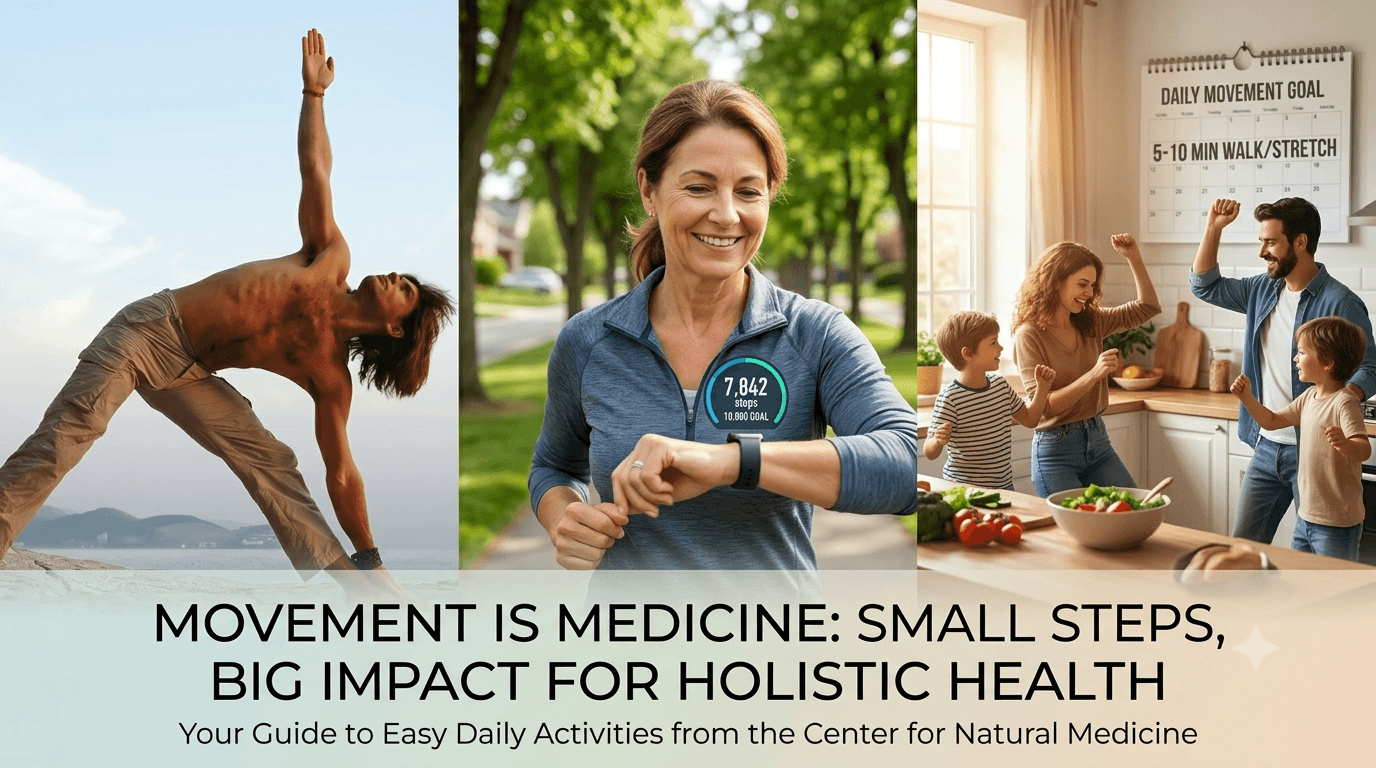
Quick Answer: Daily movement doesn't need to be intense to matter. Even a few thousand steps a day can lower your risk of things like heart disease and diabetes over time. This blog gets into what the research actually says about step counts, why moving helps you physically, mentally, and even socially, and how small habits, a short walk, some stretching, taking the stairs instead of the elevator, can fit into a packed schedule. There's also a note on picking a realistic step goal, and on working with a health coach if you want something more tailored to you.
Most weeks are packed. Meetings run into errands, and by the time you sit down, the day's basically over. Still, somewhere in the back of your mind you probably know that moving a little would help. And the good news is, you don't need a gym membership or some complicated fitness plan to get there. At our naturopathic medical office, we see regular movement as a natural part of holistic healthcare services, something the body actually needs to work well. Five or ten minutes a day, or a handful of extra steps, can change how you feel physically, mentally, emotionally.
The Science Is Clear: Small Moves, Big Impact
You don't need to train for a marathon to get real health benefits. A brisk 10-minute walk is enough to noticeably improve both physical and mental health counselling outcomes, according to research on the topic.
One large study followed more than 160,000 people and found that walking roughly 4,000 steps a day produced measurable benefits. Push that up to around 7,000 steps daily, and the risk of early death, heart disease, dementia, and type 2 diabetes drops significantly.
Here's what's interesting: speed doesn't seem to matter much. What counts is the total number of steps across the day, not how fast you take them. So walking to run errands, doing chores around the house, or simply getting up during a work break can genuinely move the needle on your health.
Other research backs this up too. Short, unplanned bursts of movement, like taking the stairs, stretching for a moment, or walking to another room, help lower blood pressure and lower the odds of chronic illness down the road. Put simply, small movements scattered throughout your day add up.
Why Movement Is Medicine for Your Whole Self
Moving your body isn't only about burning calories. It kicks off a chain of benefits that touch nearly every system in your body.
Physical, Mental, and Social Benefits of Movement
Physically, it builds strength and flexibility so everyday things, carrying groceries, climbing a flight of stairs, get easier. It keeps blood sugar more stable, supports your heart, and takes pressure off achy joints.
Mentally, movement triggers endorphins, the chemicals your brain uses to ease stress and help you sleep more deeply. And socially, it brings people together. A walk with a friend. A dance party in the kitchen with your kids. A weekly yoga class down the street.
In naturopathic and functional medicine, movement isn't treated as a side note to exercise, it's viewed as a foundation of self-care. It supports digestion, strengthens immunity, aids detoxification, and keeps energy moving through the body, all so you can function at your best.
Breaking Down Barriers: Yes, You Can Do This
It's easy to tell yourself you don't have time. But the truth is more encouraging than that: you don't need a gym or hours of free time to see results. You just need to start where you already are.

Small Changes That Can Make Movement Easier
(1) Try five minutes of morning stretches to wake up your body and start your day.
(2) Walk for 10 minutes during a work break.
(3) Park farther from the store entrance.
(4) Take the stairs.
(5) Dance while making dinner.
Pick a realistic goal. Something like working toward 7,000 to 10,000 steps a day tends to make a real difference over time. Consistency matters far more than intensity.
Simple Ways to Start Moving Today
A few things worth trying today:
(1) Stretch for 5 minutes in the morning to boost energy and flexibility.
(2) Walk briskly for 10 minutes, whether that's before work, after dinner, or during lunch.
(3) Try a few simple strength moves: squats, planks, wall push-ups.
(4) Bring in some mindfulness by breathing deeply while you walk.
(5) Make movement fun. Garden, bike, dance, or take the dog out.
Take That First Step
Not sure where to begin? Our health coach functional medicine specialist and functional medicine certified health coach can put together a movement plan built around your lifestyle and goals. At the Center for Natural Medicine, we're here to support you every step of the way, because that's really what it comes down to: every step counts.
Conclusion
Movement doesn't have to mean hours at the gym or a rigid workout schedule. A few extra minutes here and there, a short walk, a stretch, taking the stairs, can genuinely add up over time. What matters most is showing up regularly, not pushing yourself to the limit. Start small, stay consistent, and let movement become a natural part of your day rather than another task on your list.
Frequently Asked Questions
(1) How many steps a day should Iaim forto see real health benefits?
It depends a bit on your starting point, but research suggests you'll start noticing benefits around 4,000 steps a day. Get closer to 7,000, and your risk of things like early death, heart disease, dementia, and type 2 diabetes drops quite a bit. A good target to work toward over time is somewhere in the 7,000–10,000 range.
(2) Do I need to exerciseintensely for movementto help my health?
Not really. What seems to matter more is how many steps you rack up over the day, not how fast or hard you're moving. So a slow walk to the store, some light stretching, or a few trips up the stairs can do just as much good as a structured gym session.
(3) How much time do I actually need to spend moving each day?
Less than you'd think. Even a 10-minute walk or a few minutes of stretching in the morning is enough to make a difference, both for how your body feels and for your mental state through the rest of the day.
(4) What are someeasy waysto add more movement to a busy schedule?
Nothing complicated, honestly. Park a little farther away, skip the elevator, get up and stretch during a work break, or just dance around the kitchen while dinner's cooking. None of it needs to be intense. It just needs to happen regularly.
(5) Can movement help with more than just physical health?
It can. Beyond the physical side, things like better blood sugar and less joint pain, movement also triggers endorphins, which help with stress and sleep. And there's a social piece too: a walk with a friend or a yoga class can do as much for your mood as the movement itself.
Quick Answer: Daily movement doesn't need to be intense to matter. Even a few thousand steps a day can lower your risk of things like heart disease and diabetes over time. This blog gets into what the research actually says about step counts, why moving helps you physically, mentally, and even socially, and how small habits, a short walk, some stretching, taking the stairs instead of the elevator, can fit into a packed schedule. There's also a note on picking a realistic step goal, and on working with a health coach if you want something more tailored to you.
Most weeks are packed. Meetings run into errands, and by the time you sit down, the day's basically over. Still, somewhere in the back of your mind you probably know that moving a little would help. And the good news is, you don't need a gym membership or some complicated fitness plan to get there. At our naturopathic medical office, we see regular movement as a natural part of holistic healthcare services, something the body actually needs to work well. Five or ten minutes a day, or a handful of extra steps, can change how you feel physically, mentally, emotionally.
The Science Is Clear: Small Moves, Big Impact
You don't need to train for a marathon to get real health benefits. A brisk 10-minute walk is enough to noticeably improve both physical and mental health counselling outcomes, according to research on the topic.
One large study followed more than 160,000 people and found that walking roughly 4,000 steps a day produced measurable benefits. Push that up to around 7,000 steps daily, and the risk of early death, heart disease, dementia, and type 2 diabetes drops significantly.
Here's what's interesting: speed doesn't seem to matter much. What counts is the total number of steps across the day, not how fast you take them. So walking to run errands, doing chores around the house, or simply getting up during a work break can genuinely move the needle on your health.
Other research backs this up too. Short, unplanned bursts of movement, like taking the stairs, stretching for a moment, or walking to another room, help lower blood pressure and lower the odds of chronic illness down the road. Put simply, small movements scattered throughout your day add up.
Why Movement Is Medicine for Your Whole Self
Moving your body isn't only about burning calories. It kicks off a chain of benefits that touch nearly every system in your body.
Physical, Mental, and Social Benefits of Movement
Physically, it builds strength and flexibility so everyday things, carrying groceries, climbing a flight of stairs, get easier. It keeps blood sugar more stable, supports your heart, and takes pressure off achy joints.
Mentally, movement triggers endorphins, the chemicals your brain uses to ease stress and help you sleep more deeply. And socially, it brings people together. A walk with a friend. A dance party in the kitchen with your kids. A weekly yoga class down the street.
In naturopathic and functional medicine, movement isn't treated as a side note to exercise, it's viewed as a foundation of self-care. It supports digestion, strengthens immunity, aids detoxification, and keeps energy moving through the body, all so you can function at your best.
Breaking Down Barriers: Yes, You Can Do This
It's easy to tell yourself you don't have time. But the truth is more encouraging than that: you don't need a gym or hours of free time to see results. You just need to start where you already are.
Small Changes That Can Make Movement Easier
(1) Try five minutes of morning stretches to wake up your body and start your day.
(2) Walk for 10 minutes during a work break.
(3) Park farther from the store entrance.
(4) Take the stairs.
(5) Dance while making dinner.
Pick a realistic goal. Something like working toward 7,000 to 10,000 steps a day tends to make a real difference over time. Consistency matters far more than intensity.
Simple Ways to Start Moving Today
A few things worth trying today:
(1) Stretch for 5 minutes in the morning to boost energy and flexibility.
(2) Walk briskly for 10 minutes, whether that's before work, after dinner, or during lunch.
(3) Try a few simple strength moves: squats, planks, wall push-ups.
(4) Bring in some mindfulness by breathing deeply while you walk.
(5) Make movement fun. Garden, bike, dance, or take the dog out.
Take That First Step
Not sure where to begin? Our health coach functional medicine specialist and functional medicine certified health coach can put together a movement plan built around your lifestyle and goals. At the Center for Natural Medicine, we're here to support you every step of the way, because that's really what it comes down to: every step counts.
Conclusion
Movement doesn't have to mean hours at the gym or a rigid workout schedule. A few extra minutes here and there, a short walk, a stretch, taking the stairs, can genuinely add up over time. What matters most is showing up regularly, not pushing yourself to the limit. Start small, stay consistent, and let movement become a natural part of your day rather than another task on your list.
Frequently Asked Questions
(1) How many steps a day should Iaim forto see real health benefits?
It depends a bit on your starting point, but research suggests you'll start noticing benefits around 4,000 steps a day. Get closer to 7,000, and your risk of things like early death, heart disease, dementia, and type 2 diabetes drops quite a bit. A good target to work toward over time is somewhere in the 7,000–10,000 range.
(2) Do I need to exerciseintensely for movementto help my health?
Not really. What seems to matter more is how many steps you rack up over the day, not how fast or hard you're moving. So a slow walk to the store, some light stretching, or a few trips up the stairs can do just as much good as a structured gym session.
(3) How much time do I actually need to spend moving each day?
Less than you'd think. Even a 10-minute walk or a few minutes of stretching in the morning is enough to make a difference, both for how your body feels and for your mental state through the rest of the day.
(4) What are someeasy waysto add more movement to a busy schedule?
Nothing complicated, honestly. Park a little farther away, skip the elevator, get up and stretch during a work break, or just dance around the kitchen while dinner's cooking. None of it needs to be intense. It just needs to happen regularly.
(5) Can movement help with more than just physical health?
It can. Beyond the physical side, things like better blood sugar and less joint pain, movement also triggers endorphins, which help with stress and sleep. And there's a social piece too: a walk with a friend or a yoga class can do as much for your mood as the movement itself.
Latest Blogs

What Is Colonic Hydrotherapy? Procedure, Benefits, and Safety
Oct 17, 2026

What Conventional Medicine Gets Right and Functional Medicine Gets Right: A Fair Comparison
Oct 17, 2026

What Is a Holistic Health Practitioner? Roles, Benefits, and What to Expect
Oct 12, 2026

What Is Outpatient Mental Health Therapy? A Clear, Honest Breakdown
Aug 31, 2026

The 90-Day Wall: Why Most Wellness Plans Collapse by Month Three
Aug 6, 2026

Why More People Are Turning to a Functional Medicine Health Coach for Root-Cause Healing
Jul 14, 2026
Connect with us to begin your healing journey today.
Experience holistic healing that restores balance and vitality.

Connect with us to begin
your healing journey today.
Experience holistic healing that restores balance and vitality.
Connect with us to begin
your healing journey today.
Experience holistic healing that restores balance and vitality.
Connect with us to begin
your healing journey today.
Experience holistic healing that restores balance and vitality.
Latest New & Blogs
Related Blog Post
Related Blog Post
Newsletter Signup
Newsletter Signup
Newsletter Signup
Newsletter Signup
Get wellness tips, health insights, and exclusive updates in your inbox.
Get wellness tips, health insights, and exclusive updates in your inbox.
Get wellness tips, health insights, and exclusive updates in your inbox.
Get wellness tips, health insights, and exclusive updates in your inbox.